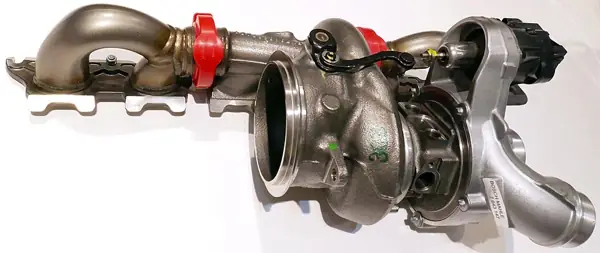
Turbocharger
Find two gas paths and one shared shaft. Which side takes energy, and which side compresses air?
Uses exhaust energy to compress the air entering the engine.
The turbine receives exhaust energy and drives the compressor through a shaft. The compressor supplies compressed intake air.
Connected to the exhaust manifold. Its compressor also connects to the intake plumbing. Position varies; some V8 layouts put turbos between the cylinder banks.
Exhaust turns a turbine wheel. A shared shaft drives the compressor wheel on the air side. The two streams stay separate. Compressing the air heats it, so charge-air cooling follows.
Reduced boost, smoke or unusual noise can have several causes, including leaking hoses and control faults—not only the turbo itself.
Think it throughA simulated engine has low boost, and you can see a leaking intake hose after the compressor. Does the low-boost reading by itself prove the turbocharger is faulty?
Show the reasoning
No. A hose leak can lose compressed air before it reaches the engine. Use the visible leak as evidence about the intake path rather than assigning every boost symptom to the turbo.
- Identify turbine, shaft and compressor separately.
- Check the connected air path when interpreting boost.