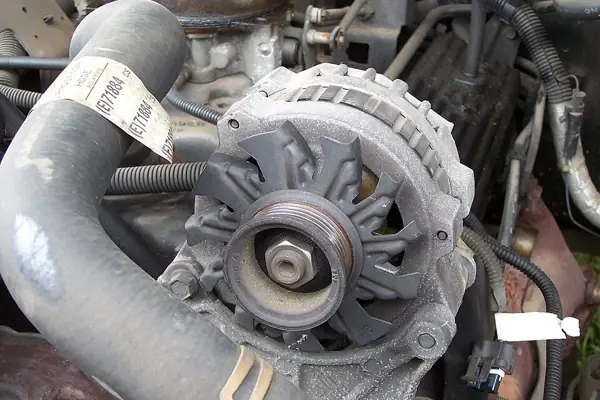
Alternator
The engine turns a pulley, but the battery needs electrical energy. What conversion happens between them?
Generates electricity and charges the battery while the engine runs.
An alternator converts engine-driven rotation into electrical power. Its rectifier converts alternating current to direct current and regulation controls output.
Mounted to the combustion engine, usually driven by an accessory belt and pulley.
A rotating magnetic field induces alternating current in the stator. A rectifier converts it to direct current, and the regulator controls output.
Charging warnings, a discharged battery or changing lamp brightness can indicate charging faults. Battery, belt and wiring problems can look similar.
Think it throughA charging warning appears in a simulated belt-driven system. Before naming the alternator as the failed part, which connected items from this lesson also deserve consideration?
Show the reasoning
The belt, battery and wiring are part of the same charging story. The warning identifies a concern; it does not establish that the alternator alone caused it.
- Trace mechanical input and electrical output.
- Include the drive belt and electrical connections.